
Sevgi, müzik, gökyüzü, neşe
Archetype: Gökyüzü ineği, kozmik şefkat
The sky and the stars within it
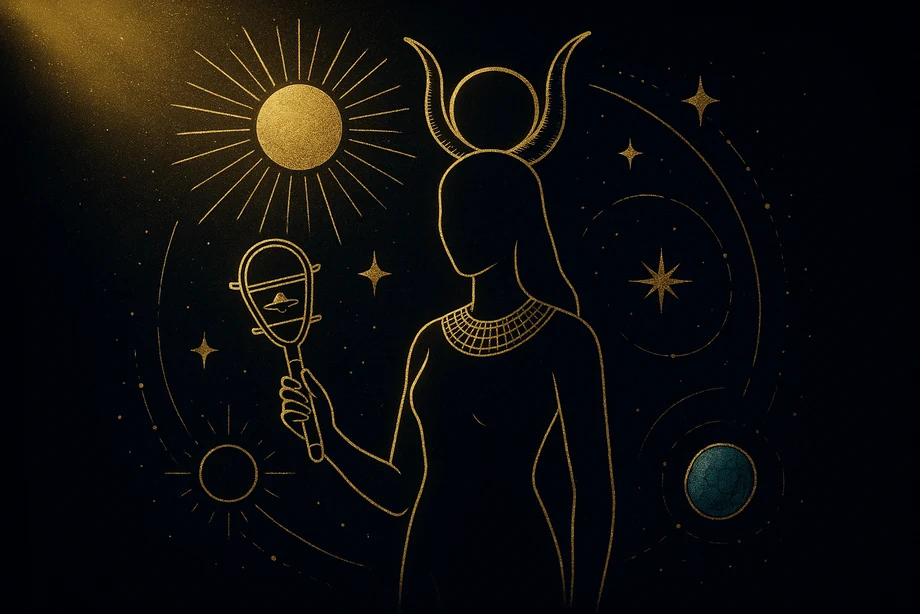
Hathor's Egyptian name was Het-Heru, meaning "the house of Horus." This name explains her cosmic nature at once. For the Egyptian, Horus was the falcon flying across the sky; Hathor was his house, that is, the sky itself. This is one of the most beautiful images in the ancient world: a goddess is not a place, she is the shell that holds the place.
Some of her earliest depictions show her as a celestial cow whose body is adorned with stars. When the Egyptian looked up at the night sky, they saw Hathor. The stars were the ornaments along her belly.
Ra the sun rose in the east each day, set in the west, traveled all night through the inside of Hathor's belly, and was born again in the morning. So Hathor is the house of the sun as well. She holds everything inside her: night, day, birth, death, the entire cycle.
Myth keeps her family structure plural. In one telling she is the daughter of Ra, in another the wife of Horus, in another the wife of Ra. This appears to be a contradiction; the Egyptian did not see it as a problem.
The nature of the goddess could not be confined by roles. She could be daughter, wife, mother, queen, everything at once, because the sky is also at once the place of birth, of shelter, of bed, of stars, of season, all together.
The one who gave music to humankind
Hathor was the goddess of music, of dance, of joy. In ancient Egypt music was, alongside entertainment, a religious practice; it was the backbone of temple rites. Hathor's sacred instrument was the sistrum, a rattle with small metal rings. Priestesses of the temple sang songs while shaking this instrument.
In the reliefs of the temple of Hathor at Dendera, women are shown dancing before the goddess, shaking sistrums. This temple is one of the most graceful structures in Egypt, and on its ceiling is an astronomical map, with diagrams of the zodiacal cycle, the lunar cycle, and the rising of Sirius drawn across it. Hathor is closely tied to astronomy and to the idea that the calendar has its own rhythm, like music.
Another important role of Hathor was her coming as the Seven Hathors. For the Egyptian, when a baby was born, seven goddesses called the Seven Hathors would arrive and speak the fate of the child. This is a figure similar to the Moirai of Greek myth or the Parcae of Rome, but the Hathors were not judgmental in tone, they announced.
They were not bringers of ill fate but sisters who whispered the tone of fate.
Dendera, Sinai, and the goddess of mines
Hathor's main cult center was the city of Dendera in Upper Egypt. The temple there still stands largely intact today, and it is one of the best-preserved temples of the ancient world. At Dendera a rite was held each year in which the statue of Hathor was taken out of the temple, placed on a boat, carried up the Nile to the city of Edfu, and joined there with the statue of Horus.
This rite was known as the "Sacred Union" and involved several days of festival. The yearly meeting of the goddess with Horus was, for the Egyptian, a seal of seasonal abundance.
But Hathor was not only at the temple. At the turquoise and copper mines on the Sinai peninsula she was also the main goddess. " Before a mining expedition set off, prayers were said to her, and the ore that was brought up was considered her gift.
This is a curious and important detail. Hathor was not only the goddess of the city, the temple, the queen; she stood with the worker too, far away in the desert, deep in the mine. Her tenderness did not recognize class.
Hathor was also known in neighboring cultures. At Byblos she was identified with a local goddess, in Sinai she was called by another name. The Greeks linked her with Aphrodite, since both were connected with love, beauty, music, and joy. But Hathor was larger than Aphrodite; she was the sky itself.
The depth of joy that rivals solemnity
What does Hathor say to us today? In the modern age, joy, gladness, dance, and music are sometimes considered "not serious," "superficial." The message of Hathor is exactly the opposite: joy is a cosmic category, as lofty and as wide as the sky itself.
The Hathor within us is the voice that can accept the joyful, aesthetic, sensual face of life. To taste a glass of wine, to be caught by the rhythm of a dance, to listen to music for hours, to smell perfume, to speak beautiful words to someone you love, these are not side activities. They are the gifts of the goddess.
The Egyptian knew that life, no matter how orderly, would remain incomplete without Hathor.
She has a shadow too, yes. When Hathor energy loses its balance, it can turn into joy that stays on the surface, that flees depth, that recoils from seriousness. But in her balanced face, Hathor teaches that depth and surface are the same thing.
Within her belly are both stars and sun, both gravity and play. The Seven Hathors came at the birth of a child because the beginning of a life is itself a celebration. The same is true for us: simply being alive is a wonder, and the way not to forget that wonder is to remember the seriousness of joy.
The voice within
Hazzın, müziğin ve maddi dünyanın kutsanmasının arketipi. Bedene gelmenin utancı değil sevincini taşıyan ses. Modern okumada haz kapasitesinin onarımıyla ilişkilidir.
"O ki sema ineğidir, sütüyle yıldızları besler." Dendera tapınağı yazıtı, Geç Dönem.
Sources: Dendera Tapınağı yazıtları ve tavan astronomik haritası · Piramit Metinleri · Tabut Metinleri · Plutarkhos, Isis ve Osiris Üzerine · Sina turkuaz madenleri yazıtları · Yedi Hathor papirüsleri

You can ask a question about this reading
Hypatia (Bilge Astrolog) answers your questions about Hathor