
Yeraltı, ölü dünyası, kabul
Archetype: Sessiz ölüm sahibesi
One of Loki's three children
Hel's story does not begin like the others, with a birth. It begins with an exile. In Gylfaginning 34, Snorri tells of her family and her fate together. Loki had three children with the giantess Angrboða: the wolf Fenrir, the world-encircling serpent Jörmungandr, and Hel. The three of them lived in Jötunheimr, the realm of giants.
When the Aesir learned of these children, their seers told them what these three would one day do, and they acted. Snorri's telling here is striking, because it reveals the gods' fear plainly. They cast the serpent into the sea so it could grow large enough to encircle the world.
They bound the wolf in chains.
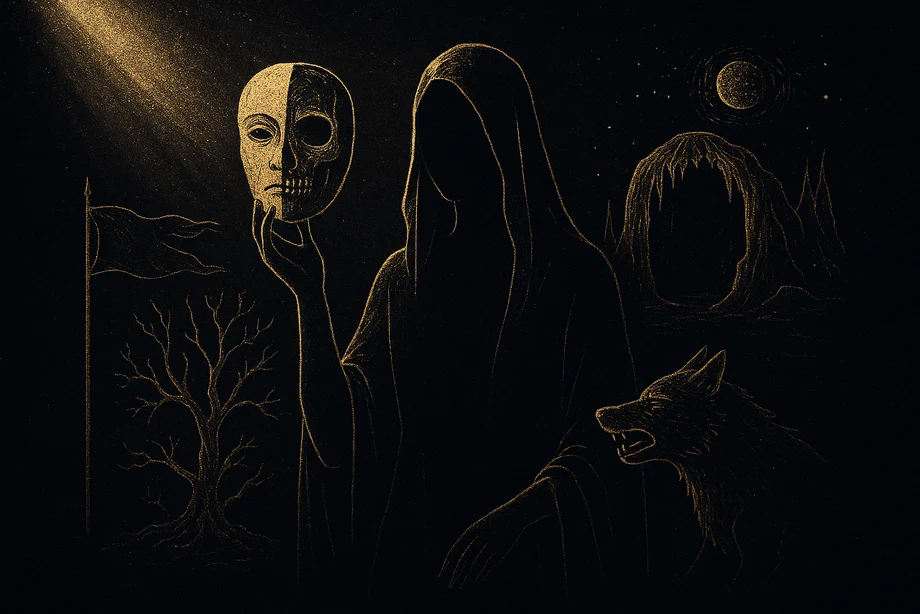
This sentence matters. Hel was not born from punishment, she was given a task. Snorri describes her: "Half her face is the color of living flesh, half is pale and dark, like a corpse.
" This physical doubleness is the summary of the whole myth. The goddess says that nature and death can stand in the same body. It is not something to fear; it is simply what it plainly is.
The Sick-Bed and the knife called Hunger
When Snorri describes Hel's kingdom he names every thing in it. " Her plate is Hungr, Hunger. Her knife is Sultr, again Hunger or Famine.
Her bed is Kör, the Sick-Bed. The threshold where one enters is Fallandaforað, the Danger of Falling. Her servants are Ganglati and Ganglöt, the slow-walking man and the slow-walking woman.
At first hearing these names seem frightening. But the myth uses them not to scare but to classify. Hel's kingdom is not the kingdom of warriors.
In Valhalla those who died by the sword make merry, in Sessrúmnir Freyja's hall holds half of the slain, but those who go to Hel are different: those who died in bed, those who died of old age, those who fell sick, the women, the children, the ordinary people.
Old Norse culture did celebrate death in heroic frames, yes, but the myth was honest, because in real life the great majority of people did not die by the sword. They died in a sick bed, they died of cold, they died in childbirth, they grew old. These people too needed a goddess.
Hel did not refuse them; she received them in her unshowy hall. Her kingdom is quiet. No music, no quarrel, no feasting board.
Only acceptance.
When Christian missionaries came north, they used the Old English word hel to render their concept of damnation, since in that language Hel was both the name of the goddess and the name of her realm. Modern English hell comes from this root. But a great translation drift took place: the Christian hell is punishment, judgment, eternity.
Hel's kingdom is not punishment, not judgment, and it takes everyone who dies. Without knowing this difference the myth is misread.
The arrival of Baldr and the tear of Þökk
Hel's most striking scene comes after the death of Baldr. Snorri tells it in Gylfaginning 49, and the Poetic Edda's Baldrs draumar echoes it. When the bright god Baldr is killed under the mistletoe sprig through Loki's trick, his mother Frigg and his father Odin are devastated.
The god Hermóðr takes Odin's horse Sleipnir and rides downward, for nine nights and nine days, into the realm of the dead. He reaches the gate of Hel's hall.
When he enters, he sees Baldr: seated in the seat of honor in Hel's hall. The goddess did not belittle him; she placed him at the head of her kingdom. Hermóðr asks her to give his brother back.
Hel's answer is very graceful. She says: "If Baldr is truly loved this much by all, if every thing in the world, living and not living, animal, plant, stone, weeps for him, let him return.
The gods sent messengers to every corner of the world. All wept: humans wept, animals wept, even stones shed tears like dew. Then in a cave they found an old giantess named Þökk. Þökk did not weep. "Let Hel keep what belongs to her," she said. The narrator adds: it is believed that the old woman was Loki.
The tone of Hel in this scene is instructive. She does not bargain, but she listens. She is just, but not cruel; she binds justice to a clear condition, and when the condition is not met she keeps.
She is not a goddess angry at the Aesir; she simply does her work. In the myth there is no rage against her. The grief comes not from her, but from the single tear Loki, as Þökk, refused to shed.
Queen of the quiet descent
What does Hel say to us today? In astrology she touches the transformative depth of Pluto and the closing cycles of Saturn. The descending courage of Scorpio and the structure of Capricorn that knows how to hold old age belong to her.
The Hel within us is the goddess of quiet deaths. In our lives some things end with great drama, yes, but more end quietly. A relationship quietly dimming. A dream quietly fading. An identity quietly shedding. A young person quietly becoming an adult. A body quietly growing old. Hel is the mistress of these quiet passages.
Modern depth psychology knows her role well. The long, undramatic, inward withdrawals that Carl Jung called "the dark night of the soul" are descents into Hel's hall. There is no heroism there. Only acceptance. The bed is called the Sick-Bed because the myth honors quiet exhaustion too.
The deepest lesson of the myth is this: Hel is not evil, not dramatic, not to be feared. She is only honest. "I am what I am," she says with the two colors of her face.
Half the color of living flesh, half the gray of ash. When the Hel within us ripens she teaches us this: instead of denying our own descent, sit with it. Some grief seasons, some flat times, some quiet transformations do not ask for an action; they ask for the way a queen sits.
Back straight, words few, the door open. Justice unbargained, but no being treated roughly. Hel's hall delivers a small lesson with great courtesy: when we give value to quietness, we open ourselves to the true grief living inside us.
The voice within
Sessiz, dramatik olmayan kabulün arketipi. Savaşta değil de yataklarında ölenler, sıradan kayıplar, gösterişsiz son. Modern derinlik psikolojisinde durağan içsel iniş süreçlerinin sesidir.
"Hel'in yüzünün yarısı diri renktedir, yarısı ceset gibi koyu, krallığı sessizdir." Snorri, Gylfaginning 34.
Sources: Snorri Sturluson, Düzyazı Edda (Gylfaginning, özellikle 34 ve 49) · Baldrs draumar, Şiirsel Edda · Völuspá, Şiirsel Edda · Vafþrúðnismál, Şiirsel Edda · Saxo Grammaticus, Gesta Danorum
You can ask a question about this reading
Hypatia (Bilge Astrolog) answers your questions about Hel