
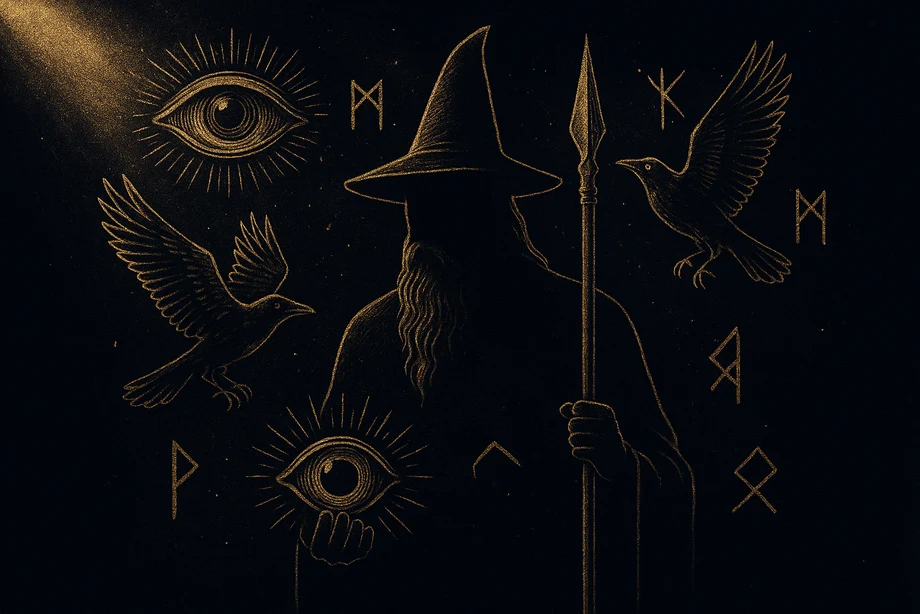
Bilgelik, kurban, kehanet, savaş
Archetype: Kurbanla bilgelik kazanan
The world made from Ymir's body
In Gylfaginning, the part of the Prose Edda Snorri Sturluson wrote in early 13th-century Iceland, he says that in the beginning there was only a gap, Ginnungagap. On one side lay fiery Muspelheim, on the other icy Niflheim. From the first drop of melting ice the giant Ymir was born, and the cow-like creature Auðumla nursed him.
Then came the three sons of Borr: Odin, Vili and Vé. They killed Ymir. According to Snorri, they made the earth from his flesh, the seas from his blood, the mountains from his bones, the sky from his skull, the clouds from his brain.
They named the world they made Miðgarð, the middle place. Later, on a shore, they found two driftwood trunks, named one Askr and the other Embla, and gave them breath, awareness, warmth. The first human pair was born this way.
Odin's nature shows itself immediately in this creation scene. He was never a simple king. He is the one who shapes, who divides, who gives life, but also the one who tears a giant apart.
Snorri calls him Alföðr, the All-father. Yet his titles run past a hundred. In Grímnismál Odin lists his own names: Yggr, the Terrible; Hárr, the High; Bölverkr, the Worker of Evil; Síðgrani, the Long-bearded.
Which face he wears, he chooses according to the moment.
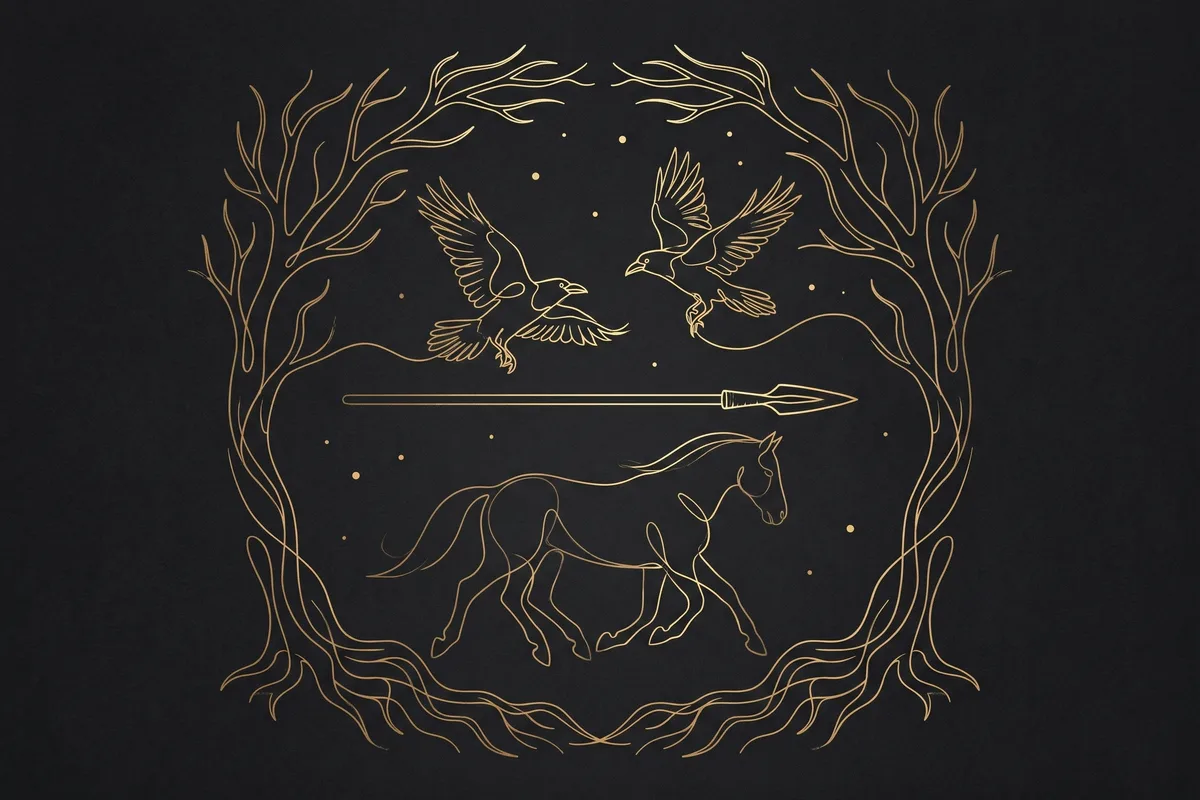
Mimir's well and the nine-night tree
Odin was not the strongest of the gods. He was the one who asked the most questions. As Snorri tells it in Gylfaginning, the wisdom-god Mimir was the keeper of a well beneath Yggdrasil, whose roots reach into nine worlds. Whoever drank from that well saw what is hidden. Mimir let no one drink for free.
Odin pulled out one of his eyes and dropped it into the well. In return he was given a single sip. From that day on he looked at the world with one eye, but what he saw was deeper than what two eyes can hold.
Snorri tells us elsewhere that after Mimir was killed, Odin preserved his head with herbs, called speech back into it with runes, and the severed head became his counselor. Knowledge always comes to him paired with a loss.
But the most striking sacrifice Odin made was not this one. In stanza 138 of Hávamál, in the Poetic Edda, Odin speaks in his own voice:
"I know that I hung on a windy tree nine long nights, wounded with a spear, dedicated to Odin, myself to myself, on that tree of which no man knows from where its roots run."
No one gave him bread, nor a drink from a horn. He looked down, seized the runes, screaming he seized them, and fell back. This scene is the densest moment in the myth, because Odin is at once the one who offers the sacrifice and the one offered, both priest and gift.
Snorri only briefly recalls the story in the Prose Edda, but Hávamál tells it to us in the god's own mouth. Knowledge does not come cheap. The runes, that alphabet of secrets, open only to someone who gives himself to himself.
Two ravens, an eight-legged horse, the temple at Uppsala
Odin's symbols tell us what he does. His spear Gungnir, once thrown, never missed its mark; Snorri says in Skáldskaparmál that it was forged by dwarves. His horse Sleipnir had eight legs and could run through all nine worlds. Snorri also tells the story of this horse's birth: Loki, in the shape of a mare, deceived a stallion, and later bore Sleipnir.
On his shoulders he carried two ravens. Their names are given in Grímnismál: Huginn, Thought, and Muninn, Memory. Every morning they flew out across the world, and in the evening they whispered into Odin's ear what they had seen.
" Losing his memory frightened him more than losing his thought.
Late in the 11th century, Adam of Bremen describes the great temple at Uppsala in Sweden. Three gold statues stood there: Þórr in the middle, with Wodan (Odin) on one side and Frikko on the other. Every nine years a great blót, a bloody sacrificial feast, was held.
Nine male dogs, horses, and humans were hung from the trees of the sacred grove. The description is colored by the eyes of a Christian historian, but the core is honest: people offered sacrifice to him, because he had offered himself to himself. At the opening of Heimskringla, Snorri even tells of Odin as a historical king, a migrant leader from Asia.
Myth and history interweave in this figure.
The price paid for knowing
What does Odin say to us today? In astrology he carries echoes of both Mercury and Saturn. Mercury's communication, the secret of the runes, the messenger ravens; and Saturn's structure, sacrifice, the ripening of time. The Odin within us is the voice that asks what we are willing to give in order to truly know something.
Most people want knowledge cheap. Odin does not work that way. In exchange for one eye he received depth.
Instead of a single night of comfort he chose nine nights. Standing at Mimir's well he weighed his trade: what is this gift worth to me? In modern life this threshold appears again and again.
Reading a book in earnest, staying inside therapy in earnest, being present in a relationship in earnest, becoming truly skilled at a discipline, each asks us to bid farewell to some side eye, some side comfort, some side identity.
His shadow is here too. Odin's search can turn destructive, since the god recognizes no limit when it comes to knowledge. In the myths he deceives, changes shape, ruins kingdoms.
Unripe, his energy turns into intellectual greed, into believing oneself above everything, into sacrificing those closest to oneself. But when it ripens, it learns: real wisdom is knowing what you will pay. The runes are seized with a scream, but yourself to yourself.
No one can be hung on the tree on someone else's behalf.
The voice within
Bir şeyi öğrenmek için bir başkasını feda etme kapasitesinin arketipi. Tek gözün karşılığında derinlik, bir gecenin karşılığında run'lar. Modern okumada içsel arayış için verilen sınırların sesidir.
"Yggdrasil'in dalına astım kendimi, dokuz gece, mızrakla yaralı, kendimi kendime kurban ettim." Hávamál, 138.
Sources: Snorri Sturluson, Düzyazı Edda (Gylfaginning, Skáldskaparmál) · Snorri Sturluson, Heimskringla · Hávamál, Şiirsel Edda (138-145, Rúnatal) · Grímnismál, Şiirsel Edda · Vafþrúðnismál, Şiirsel Edda · Bremen'li Adam, Hamburg Kilisesi Tarihi (Uppsala tasviri) · Tacitus, Germania
You can ask a question about this reading
Hypatia (Bilge Astrolog) answers your questions about Odin