
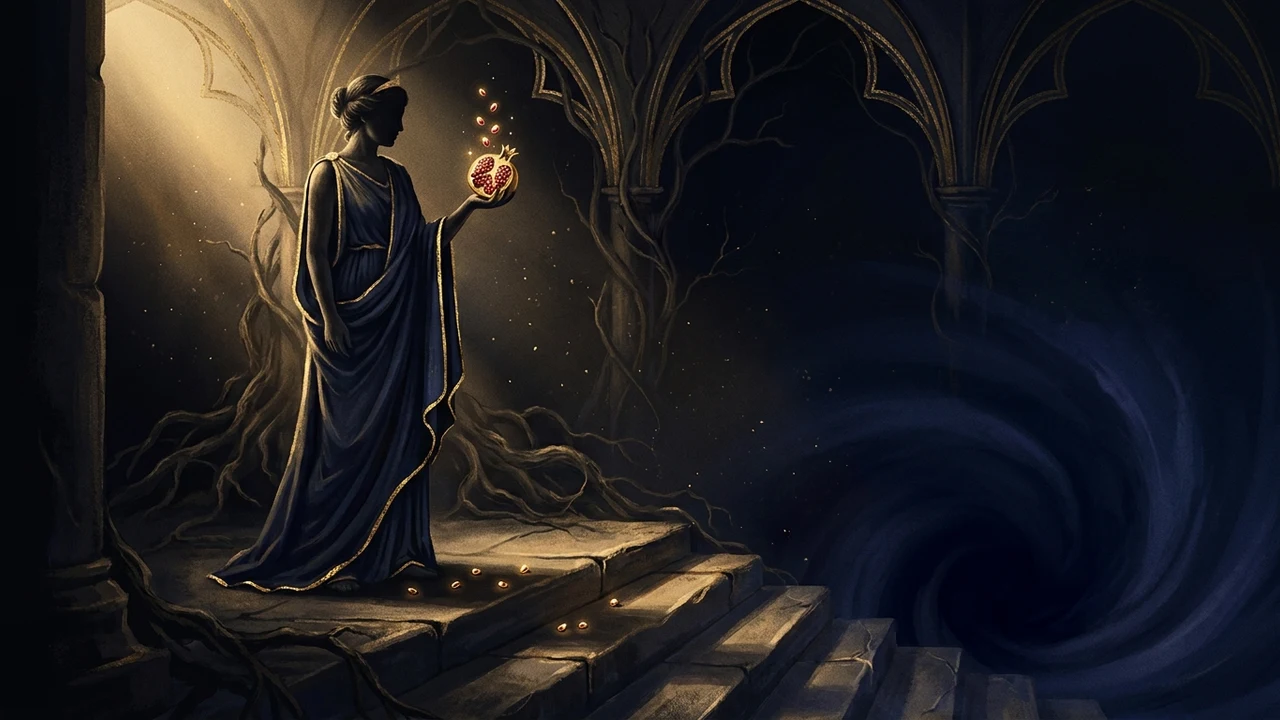
In the south of Sicily there is a place called the Plain of Enna. Spring comes late there, but when it comes it wraps the whole plain in a single day. Violet, narcissus, hyacinth, all of them rise from the earth in one night. The ancient Greeks believed this was truly the place where the goddess of spring walked. And the story does begin there, with a girl bending to pick a narcissus.
Her name back then was Kore. It means "young girl". She had grown up at the side of her mother Demeter, the daughter of the mother of harvest, wheat, and grain. There was always a flower around her, always light. She was the most sheltered child of Olympus. Her fair hair fell to her shoulders, her smile made the plain tremble. And that day, the moment she bent to pick that narcissus, the earth split open.
The chariot that came from the underworld
From the place where the earth split, a chariot drawn by black horses rose up. The chariot of Hades. The king of the underworld, the lord of the dead, the god who is never seen. The Greeks even avoided speaking his name, because to say a god's name was to summon him. But there, in the middle of the plain, unsummoned, he appeared.
He took Kore in one motion, set her in the chariot, and they returned beneath the earth. The crack closed. Only the unpicked narcissus was left on the ground.
Myth tellers usually pass over this part quickly. "Hades carried her off," they say, and turn to the next scene. But it is worth stopping there for a moment. Because the one question we will ask through the rest of the story is really this: why did Hades choose her, why that day, why that narcissus? The old texts say two things. The first: Zeus had consented to this abduction. Hades was his brother and the only god without a wife in the underworld. He needed a bride, and Kore was the most beautiful. The second is stranger: the narcissus flower had been scattered on the earth by Hades himself. So the flower was a trap. Kore did not know what she was bending toward.
This detail matters, because the scene we read as an abduction carries the core paradox of the whole myth. On one hand Kore seems like a victim, but on the other hand it is she who chose that narcissus. The splitting of the earth is not a coincidence. It is a call. And the moment the young girl heard the call, she had already bent down.
The mourning of Demeter
Up above, the moment Demeter hears the news she loses her mind. Her daughter is gone. No god, no nymph, no bird will tell her where she went. For nine days and nine nights she searches the world, two torches in her hands, neither eating nor sleeping. On the tenth day she asks Helios, the sun, because the sun sees everything. Helios tells her: Hades took her, Zeus allowed it.
At this Demeter leaves Olympus. She sets her godhood aside, takes on the guise of an old woman, and goes to a small town called Eleusis. No one knows her. But something else goes with her. The fruitfulness of the earth.
The wheat grain stops setting. The fields dry up. The trees bear no fruit. The animals do not give birth. A famine begins in the world, and people start dying one by one. The gods watch this from Olympus, and in the end they understand: if they do not bring Demeter back, the human race will come to an end. And if the human race ends, who will offer sacrifice? Who will burn incense? The gods feed their godhood on the prayers of people. Demeter's mourning threatens the whole order.
Here the secret of the myth opens once more. Demeter's mourning is not an exaggeration. The fruitfulness of the earth truly depends on a lost girl. Spring truly is the return of a goddess. The Greeks did not invent this story to explain the seasons. Because they lived the story, they saw the seasons this way. There is a difference between the two.
The months spent in the underworld
Now let the scene turn downward, to the underworld. The palace of Hades. Dark, yet bright. Cold, yet calm. Kore stays there one month, then two, then three. At first she weeps. Then she falls silent. Then she begins to look.
The underworld shows her something other than what she has seen until then. In the land of the dead the souls move about, each one with a story. Some have long forgotten who they were, some still think they are alive. The river Cocytus flows slowly, carrying the water of tears. There is the river Lethe, and whoever drinks from it forgets. There is the Styx, and even a god who swears on it cannot break his word. Kore learns this place. She becomes its queen. Hades had taken her by force, but in the underworld he does not hold her by force. He gives her the throne, beside his own.
And one day, when the bargain for her return is being made, Hades holds out a pomegranate seed to her.
This scene is the most mysterious in the myth. Because everyone knows: whoever eats something in the underworld is bound to it. This is a rule, an ancient rule, and Hades has told it to Kore. But Kore eats. In some versions six seeds, in some four, in some only one. But she eats. And with that eating she binds herself halfway to the underworld.
The myth usually tells this as a trick of Hades. But if we read it another way, Kore may have eaten because she wanted to eat. Because in the underworld, in spite of all the pain and all the dark, she has for the first time become her own. Beside her mother she was Kore, "young girl". In the underworld she took another name. Persephone. The destroying queen. The guardian of the dead. Someone known by her own name. If she returns she loses this name too. By eating the pomegranate seed she really chooses something: that four months of the year, four months of her life, will belong to her own queenship.
When spring returns
The bargain is made. Kore spends one part of the year with her mother, one part with Hades. When she goes up, Demeter is happy, the earth turns green, flowers bloom, the harvest comes. This is our spring and summer. When Persephone returns to the underworld, Demeter mourns, the earth withdraws, the trees shed their leaves. This is our autumn and winter.
The Greeks did not only explain the seasons this way. They explained something else too. The two states of a human being. Above, a girl, below, a queen. Above, her mother's daughter, below, the owner of her own self. For the Greeks, anyone who has not lived this doubleness has stayed incomplete. Persephone is both lost and found, both dead and alive, both innocent and wise. And what we call transformation is the very going back and forth between these two.
At Eleusis, for centuries, the secret rites of this story were performed. Everyone who took part in the rites called the Eleusinian Mysteries swore never to speak of them to anyone for the rest of their life. Even today we do not know exactly what they were. But this much is known: the one who did the rite symbolically lived Persephone's journey again. They descended to the underworld. They touched the dark. And when they came back up, they no longer feared death the same way.
To swallow a pomegranate seed
What does this story say to you today? Maybe you came to a moment of loss not long ago. Maybe something was drawn down beneath the earth, at an hour you never expected. Maybe a chariot took you too, away to a place you never wanted. A lost job, a separation, an illness, a death. The myth says, first you cry out. Like Demeter. Then you search. Then a kind of anger comes that you cannot make sense of, then acceptance. This is true, but it is not the whole story.
Persephone's secret is this: she wanted to stay in the underworld. Even to say it unsettles some people. Before grief could take her over completely, she bit the pomegranate seed with her own hand. Because down there she saw, touched, learned something she could never have seen above. She had stepped out of her mother's shadow. Now she had her own name. Her own throne.
If you have met a Hades moment in your life, see also that the moment did not only make you a victim. It gives you a crown too. Years later you look back, and there is something you could not have known if your heart had not broken. A depth you could not have loved without the mourning. The months spent in the underworld are not wasted. They lay the ground for the grown self you would never have met if you had stayed only a "girl" up above.
And when your spring returns, the one who comes back is no longer you. The one who comes back is two people. The one who walks above, and the one who stayed below. The two never let go of each other again. Persephone leaves half of herself in the underworld with each descent, and half of herself above with each return. That is why she is the goddess of both life and death.
Maybe one day, when you take a pomegranate in your hand and open it seed by seed, you will remember this. Inside every person who has eaten one seed, there is always a little of the queen.
You can ask a question about this reading
Atlas (Mit Anlatıcısı) answers your questions about The Descent of Persephone: The Pomegranate Seed and the Season of the Underworld
Comments
You can share your thoughts about the piece here.