
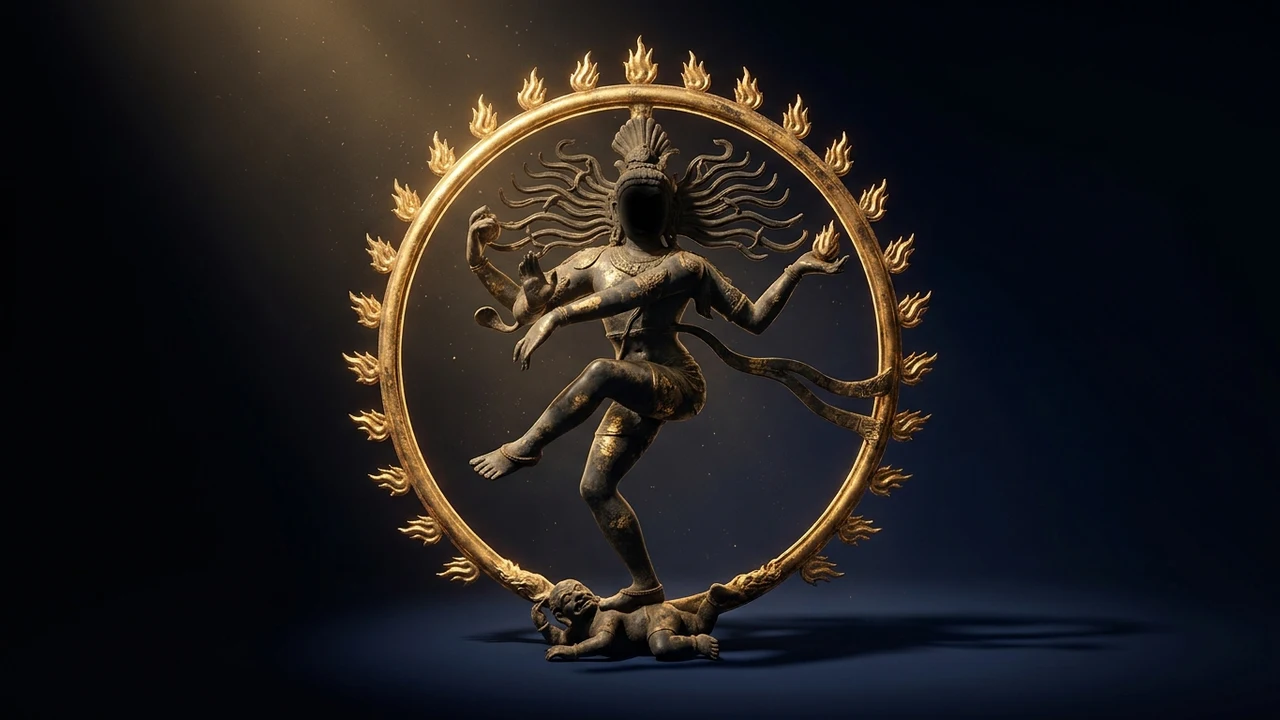
In a village in Tamil Nadu, in the time of the Chola dynasty, around the eleventh century, a casting craftsman melted bronze. He had prepared the wax model beforehand, the mould was dry. The bronze flowed into the mould, cooled, and out of it came a figure. A dancing god. His right foot presses to the ground, crushing a demon beneath it. His left foot is in the air, lifted across his body, bent at the knee. He has four arms. In one a small drum, in one a flame. The other two make different signs, one says "do not fear", one points to the ground. Around him a ring of bronze, and along the inner edge of the ring flames flicker out with their tongues. His hair is flung to both sides, like cords. On his face a smile. Neither sorrowful nor joyful. A calm smile.
The name of this statue is Nataraja. "The Dancing Lord." And that dance is the deepest symbol of Hindu mythology. Because the name of that dance is Tandava, the dance of destruction. But if you look beneath the word destruction, something quite different is hidden.
Why Shiva dances
In the Hindu pantheon there are three great gods. Brahma is the creator, he brings the universe into being. Vishnu is the preserver, he holds the universe up. Shiva is the destroyer, he scatters the universe. The three together are the Trimurti, the threefold form. Creation, preservation, destruction. Without these three, something stays incomplete.
A Western reader is surprised on first hearing this. Why is the destroyer god loved? Why is he worshipped? Why do his statues stand in every corner of India, in every village, under every tree? Because Hindu thought says this: destruction is not opposed to creation. Destruction is the precondition of creation. Without clearing a space, nothing new can be built. Until a cell dies, a new one cannot be born. Until a season ends, another cannot begin. Shiva is this clearing force. His destruction is not apocalypse, it is the making of room.
And Shiva does not do this with force, with harshness, with tears. He does it by dancing. Tandava is the name of it. Shiva dances, and with the rhythm of his dance universes are born, universes die. His drum is the sound of the beginning of time. The flame in his palm is the moment the universe ends. Both hands at once. His four arms stand for the four directions, the four ages. The name of the demon crushed under his foot is Apasmara, which means "ignorance". Shiva does not kill it, he only crushes it, because if ignorance is killed people do not value knowledge. It is always there, but crushed, held in check.
One night, inside a ring of flame
A story is told about why Shiva began to dance the tandava. In one version of the Hindu sacred books, this is written.
There were ignorant scholars, who took themselves for true sages. They gathered together inside a forest. And they said, "No god can stand before our knowledge, because we know every word of the rites by heart, we apply their rules, no one is higher than we are." Shiva hears this. Together with his wife Parvati he takes on the guise of a plain man and passes by.
The scholars do not recognize Shiva. They take him for an ordinary person. They even look askance at his wife Parvati. Shiva stops. He makes no sound. The scholars send their spells against him, a dark demon, a tiger, a serpent, all of them attacking at once. Shiva calmly turns each one aside. At this the scholars raise up out of the earth, as a last resort, a figure called Apasmara, the demon of ignorance. Apasmara stands against Shiva. And there, in the middle of that forest, Shiva begins to dance the tandava.
He dances. He steps onto Apasmara, he crushes him. Around him a ring of flame appears. His hair scatters. The drum begins to beat, the rhythm shakes everything. The scholars sink to the ground one by one. Their demons evaporate. Their charms break. Shiva dances without stopping, until all the ignorant knowledge has fallen. In the end he stops. The scholars rise to their feet, they bow down, "Who are you?" they say. Shiva answers, "I am the dance of destruction itself. You cannot summon me with a rite. You cannot win me by memorizing. I appear only where you thought your knowledge had gone stale, I undo it, and I open your eyes to me."
The lower layer of this story is this. The tandava is not only a cosmic dance. Shiva comes wherever a heap of knowledge has formed and needs to be broken. When a belief has grown old in a person's heart, when a habit has clogged a life, when a shell has gone dull in a love, Shiva appears there. He beats the drum, he lights the flame, he dances. You either resist this or you let it go. If you resist you become Apasmara, you are crushed. If you let go, you join the dance, and you too are renewed.
Why the ring is flame
Someone who looks long at the statue notices something. Shiva is inside the ring of flame. The ring surrounds him, but does not swallow him. What does this mean?
Hindu thought says the ring is prakriti, the visible universe. Matter, time, form, all of it. Shiva dances inside it but is something separate from it. He is at the centre of the ring. The ring turns, the flame flickers in and out, but the centre stays still. If you watch the ring, you get caught in the flame. If you watch the centre, you see Shiva. When you see the centre, the flame does not burn you and the dance does not fling you, because in that moment you too have a centre, and that centre is made of the same matter as Shiva's centre. Hindu philosophy has repeated this equality for thousands of years. You are not the one dancing inside the flame. You are the silence standing at the centre of the flame.
This claim comes across as striking when it is read one evening. Years later you understand what it says. Because in life you really do fall inside rings of flame. An illness, a loss, a crisis. Everything around you burns, the dance quickens, the drum spins inside your head. In that moment you think you are only flame. What the Hindu myth says is this: stop for a second, and look, in the middle of all this there is a centre, and that centre is you. The flame passes, and you remain. This is Shiva, and at the same time it is you too.
Parvati's question
Shiva does not always dance this dance alone. He dances it together with his wife Parvati, and in some versions Parvati dances more fiercely than Shiva. When she appears as Kali, Parvati is a dark goddess, a garland of severed arms hung around her neck, her tongue out, she is the dance of destruction itself. The story tells that one day Kali grows so carried away with the dance that she does not stop. Her destruction does not stop. The universe is in danger, because Shiva's destruction is measured but Kali's frenzy crosses the line.
Then Shiva lies down on the ground. Without knowing it, Kali steps onto him. For a moment she stops, she realizes she is standing on her husband. Her tongue comes out in shock, and in all the iconography her tongue is always out, in memory of that moment. The dance stops. Because when Kali sees her husband she remembers, "The dance of destruction is not for destruction alone. It is for a beginning." Shiva lay down on the ground, because the only way to stop Kali's frenzy was to come beneath her foot. He stops her with love, not with battle.
What this scene says is this: destruction itself cannot be uncontrolled. The tandava is not a game, it is the art of making room. Too little destruction makes no room at all, too much destruction leaves nothing to destroy. Shiva is the god who knows this balance. He stops Parvati whenever it is needed, and Parvati calls Shiva whenever a worn-out structure has stalled. The two of them together keep up a cosmic balance.
Which habit will you destroy
What does this myth say to you today? Maybe it already describes a moment you are living. In your life a structure has clogged. A habit has gone stale. A job is narrowing you. A relationship has grown dull. A belief is no longer enough for you. You know this, but you do not dare to destroy it. Because the word destruction has always sounded to you only as destruction. As catastrophe, as loss.
The Hindu myth says something else. Destruction means making room. A season ends, it makes room for another season. A cell dies, it makes room for another cell. A habit collapses, it makes room for another life. Shiva's dance is the name of this art of making room. It is not merciless. What is merciless is refusing the destruction that is needed, because that refusal stores up a greater crisis. Shiva offers the small destruction in time, so that the great destruction is not needed.
Maybe one day, standing before the mirror, you notice an Apasmara inside yourself. An ignorance. A shell. A habit that protected you for years, but now narrows you. That demon is not to be killed, only stepped on. Not destroyed, but told "stop now". And with that stance, the ring of flame appears around you. The drum begins.
The sound of the drum is not terrible. On the contrary, it is the sound of a beginning. Shiva smiles as he dances, because he knows that destruction is the preface to a gift. And you know it too, really. You only need to stay silent for a moment to hear the drum.
Imagine a god dancing inside a ring of flame, and imagine, crushed beneath his feet, that old thing inside you. Destruction is not terrible. Destruction is room. And from that room, another flame is born.
You can ask a question about this reading
Atlas (Mit Anlatıcısı) answers your questions about Shiva's Tandava: When Destruction Is a Dance to Make Room
Comments
You can share your thoughts about the piece here.