
In the last years of the Roman Empire, a man named Apuleius wrote a book in North Africa. It was called Metamorphoses, which means "Transformations". Inside the main story he tucked a smaller one, told as a tale an old woman gives to a young girl. The old woman sat in an inn room. The girl was crying because her wedding was about to fall apart, and the woman told her this story to comfort her. She began with the words, "Once upon a time, a king had three daughters." The girl listened. The story drew in everyone who heard it. That paragraph was written eighteen hundred years ago. And to this day no one knows whether Apuleius made it up himself, or set down an older tale from Anatolia, Egypt, or Syria. Maybe both. But the story itself has wandered without an owner ever since.
Three sisters and the jealousy of love
The king has three daughters. The youngest is named Psyche. It is a Greek word meaning "soul" or "breath". She is so beautiful that people flock to the palace just to see her. She is so beautiful that they stop coming to pray to Aphrodite, the goddess of love herself. The temples of the goddess empty out.
Aphrodite grows jealous. She has been made small, not in front of Zeus, but in front of a mortal girl. She calls her son, Eros, the winged young god whose arrows nail people's hearts to one another. "Go to this girl," she says, "and make her fall in love with the most wretched, most ugly creature there is. Let her pay for this."
Eros readies one of his arrows. At night he slips into Psyche's room. He comes to her bedside. He sees her asleep. And there, something happens. Eros, the god who makes everyone fall for someone else, accidentally pricks himself with his own arrow. He falls in love with Psyche. Instantly. In that very moment. A being whose godhood had always been pure victory is, for the first time, caught beside a mortal girl. He forgets his mother's order. He leaves the room in the dark.
This scene is the first turn of the myth. Because after this, nothing goes the way anyone planned. Aphrodite is angry because her order was forgotten. Psyche is sunk in sadness, because her two sisters have married but no one wants to marry her, since she is not an ordinary girl but a wonder, and how do you marry a wonder? Her family consults an oracle, and the oracle says something terrible: "Take this girl to a hilltop. There a monster waits to be her husband."
A month with an unseen husband
Psyche is carried to the hilltop and left there. Evening comes, then night. A wind lifts her up and carries her to a palace in the middle of a valley. The palace seems empty, yet she is waited on. Unseen hands set the table, fill the cups, play the music. At night someone appears beside her in bed. In the dark. He speaks, he touches, he loves. But Psyche cannot see who he is.
"I am your husband," the voice says. "Your beloved. But you must never see my face. If you do, you will lose me. You must trust me, and love me in the dark."
Psyche trusts. Months pass. She loves the one whose voice it is without knowing who he is. She is happy in the palace. At night her husband comes, by day the unseen service goes on. But she is also lonely in that palace. Her family thinks she is dead, her sisters are in mourning. One day she asks her husband for leave to go see them. "You may go," he says, "but do not listen to your sisters. They will do you harm. They will be jealous of your happiness."
Psyche goes. When her sisters see her they are amazed. She describes her life to them: the unseen husband, every day in the palace, the voice that touches her at night. The sisters look at each other. "An unseen husband?" they say. "Then he is a monster. He does not show his face because he is hideous. One night, while he sleeps, light a lamp and have a knife ready. If he is a monster, kill him, save yourself. If he is not, he will already know, do not be afraid."
Psyche returns to the palace. The seed has been planted. Once the mind has learned doubt, it does not come back out. That night, lying in bed, a stone weight sits in her heart. Her husband comes, touches her, sleeps. Psyche waits. Then she rises. She lights the lamp. She takes the knife in her hand. She leans over the bed.
A drop of wax, and the waking god
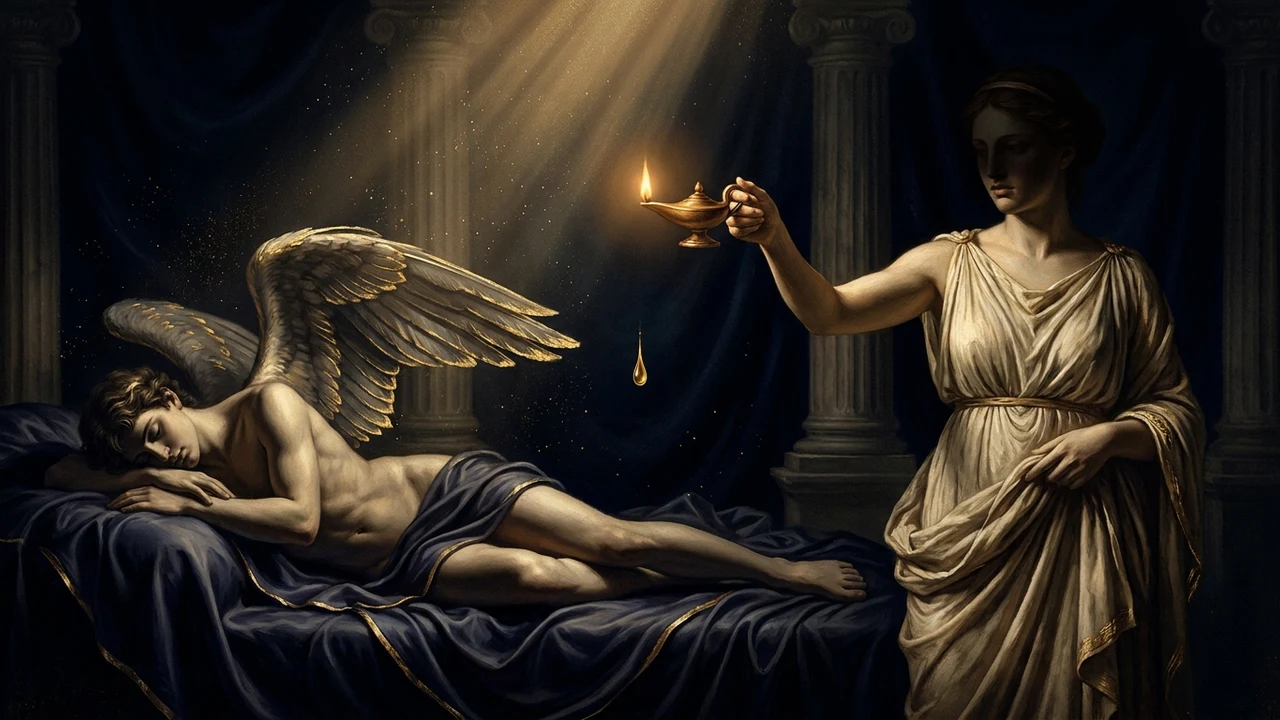
In the light of the lamp, what Psyche sees is not a monster. It is Eros, the god of love himself. Golden hair, winged, a face more beautiful than even the other gods. Psyche freezes for a moment. The knife drops from her hand. And in the shock of that moment, a drop of wax slides from the lamp and falls onto Eros's shoulder.
The hot wax wakes Eros. He opens his eyes. He sees Psyche. He sees the knife, the lamp, her frightened face. He says nothing. He simply rises, spreads his wings, and flies out the window. And as he goes he leaves behind only one sentence: "Love does not live with doubt."
That night Psyche lost the world. The palace evaporated, the wind threw her back to the hilltop, barefoot, in her nightclothes. She had no husband now, no palace, no life. Only one thing lay before her: to win it back. And she would do it not as any king's daughter, not as the offspring of any god, but as a mortal woman. Her steps pressed into the soil, because no other kind of step was left to her.
Aphrodite's impossible tasks
Psyche searches for Eros, going from temple to temple. In the end she learns the truth and goes to Aphrodite, whom she realizes is her mother-in-law. She comes before the goddess and asks for him back. Aphrodite laughs at her. "You want Eros? First prove you deserve him."
Aphrodite gives her four impossible tasks.
The first: separate every single grain in a granary, one by one. Mixed wheat, lentils, barley, corn, thousands of tons of it. How can one girl sort that out? Psyche sits down and weeps. But a colony of ants comes, sees her, takes pity. Ants in their thousands, their millions, sort the grains. By morning the work is done.
The second: gather golden wool from the sheep. But these are monstrous sheep, they attack anyone who comes near. Psyche sits down by the river and weeps. A reed speaks to her: "Wait for evening, the sheep come down to the field, by night they move among the bushes, and when they bleat in the morning gather the wool snagged on the thorns." Psyche does as it says. The wool is gathered.
The third: bring a cup of water from the river Styx at the top of the mountain. The Styx is the river of the dead, and whoever goes near it dies. Once more Psyche is helpless. An eagle sees her, the eagle of Zeus, takes her cup, flies to the mountain, fills it with water and brings it back.
The fourth is the hardest. Aphrodite gives her a box. "Go down to the underworld, to Persephone, and ask her for a measure of beauty, let her fill the box. Bring it back." This time there is no hope for Psyche, because a mortal goes down to the underworld but a mortal does not come back. Yet a tower speaks to her, tells her the way, gives her charms. Psyche descends, reaches Persephone, has the box filled, and comes back up.
The last test, and love awake
On her way back from the underworld, box in hand, a thought comes to Psyche. "What if I take a single drop of this beauty I am carrying to my mother-in-law? Who knows whether Eros will take me back? If I take a drop of beauty and look more lovely to him?"
The moment she thinks this, she opens the box. And the beauty inside is in fact a sleep. The sleep of the underworld. Psyche sinks down there, slipping somewhere between sleep and death.
Up above, Eros has healed from the burn on his shoulder. He has searched for Psyche for a while, sulked, then missed her. Now he sees her come up from the underworld and fall onto the earth. He spreads his wings and flies to her. He lifts her from the ground. He puts the sleep back in the box and closes it. He kisses her. Psyche opens her eyes.
Eros takes her to Olympus. He comes before Zeus and asks that she be given immortality so a mortal girl can marry a god. Zeus agrees. Aphrodite softens her anger, at least softens it for the moment. Psyche is given a cup of ambrosia to drink. She becomes immortal. She and Eros marry. Together they have a daughter. Her name is Voluptas, which means "delight".
What the story leaves us today
For centuries the people who read this story have tried to understand one thing: why did Eros run? Why was the drop of wax such a great break? What did Psyche do, to be punished?
The answer looks simple but runs deep. Love, in Apuleius's telling, begins unseen. In the dark. Without a name. Without a face. It begins simply as trust in a presence, a voice, a touch. And the moment that trust breaks, the moment the lamp is lit, the moment someone says "I want to see, I want proof, I want to know", the pure state of the beginning is lost.
But the myth does not stop there. Because after losing, Psyche sets out to win love back, and by doing the four tasks she learns something else. Love may have begun unseen, but once it has been seen it can be rebuilt. This rebuilding is harder. It needs the help of the ant, the reed, the eagle, the tower. Because a person alone cannot finish four impossible tasks, they have to call on the whole world around them for help.
So there are two states of love in this story. The first, the innocent state, unseen. The second, the mature state, after seeing, built with effort. They are two different things. The second cannot imitate the first, but it lasts longer than the first. Because the first is a gift, the second is a building.
Whose lamp, which night
Have you ever lit a lamp in your life? Maybe you entered a relationship, and a voice inside you said "trust", but another voice said "look closely, see, know". You lit the lamp. Maybe in that moment you lost something. An innocence, a dream, a state of being. The drop of wax fell back on you, it was hot, it burned.
The myth says, do not avoid lighting the lamp. Because seeing is not a crime. When Eros flies out the window the story does not end, it begins. What feels like an ending is actually a beginning. You are Psyche that night. The ants and the reeds and the eagles are on their way. You will go down to the underworld. You will maybe open the box, make a mistake. But in the end, if you are to meet again, this second meeting will be deeper. Because now you will love not just with a touching hand, but with a face, a name, a story.
The second meeting always comes after the first. And the name of its gift is not delight, not Voluptas, but immortality. Because the one who loves with open eyes loves without end.
You can ask a question about this reading
Atlas (Mit Anlatıcısı) answers your questions about Eros and Psyche: The Love a Drop of Wax Broke
Comments
You can share your thoughts about the piece here.