
There is a sentence carved into a clay tablet four thousand years ago. In Sumerian. Its translation is this: "From the great above she set her ear to the great below." A few words. The whole weight of the story gathers in those few words. Because a goddess heard a voice from below, and when she heard it, everything changed.
The goddess was named Inanna. The lady of heaven and of love in Sumer. The protector of the city of Uruk. She was counted a star, counted a goddess of war, counted a goddess of love. All of it at the same time. All her power, all her light, all her names were in the above. But one day, she turned her ear toward the underworld. Because down there her sister, Ereshkigal of the dark crown, was in mourning. And Inanna decided to go to her.
The seven crowns set out on the road
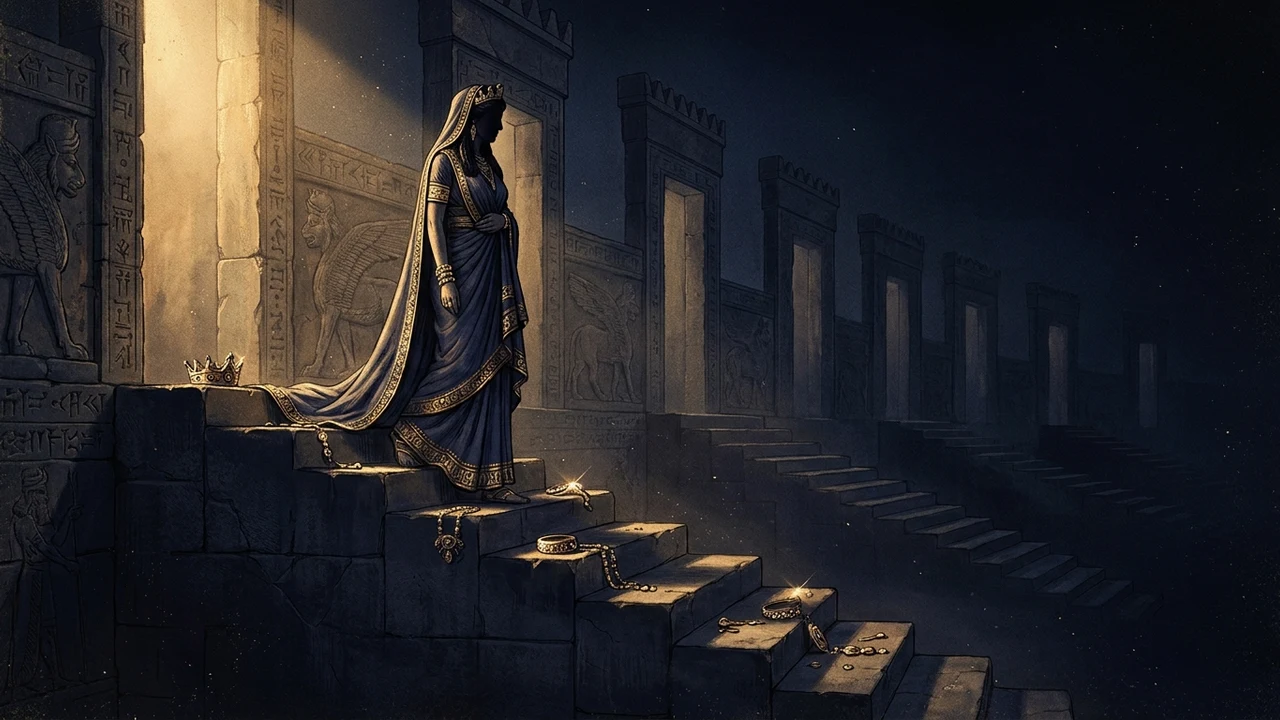
Before setting out, Inanna dressed herself. The tablets tell this scene piece by piece, because each piece is a separate power. On her head she set the shugurra, the crown of the steppe, the sign that she was queen of the plains. She fastened the rods of measure that wound through her hair. Around her neck she slid a necklace of lapis lazuli, the sky-blue stone, the stone of goddesses. On her breast a breastplate of twin stones. On her arms gold bracelets. At her waist a dagger. And her robe, the pala-robe, the robe of godhood, she threw over her shoulders.
Seven pieces. The tablets count them with care, because Inanna was going down to the underworld with all her power. She did not go empty-handed. Not one crown was missing. And she left an order with her faithful servant Ninshubur: "If I do not return in three days, send word to the gods, ask them to save me." Then she turned, and walked downward.
When the first gate appeared, Inanna asked for it to be opened. The gatekeeper was named Neti. Neti carried word inside to Ereshkigal. Ereshkigal's answer is written sharply on the clay tablet: "Let her pass through the seven gates, but at each gate let her leave a piece behind. Let her come naked before me."
Gate by gate, piece by piece
At the first gate Inanna is stopped. They ask her for the crown on her head. The shugurra, the crown of the steppe. "Why is this crown being taken?" asks Inanna, not because she does not know, but because she wants to hear that there is nothing a goddess will never surrender. The answer is short: "Be silent, this is the law of the underworld." Inanna gives up the crown. The gate closes behind her.
The second gate. The rods of measure from her hair. The third, the lapis lazuli necklace. The fourth gate, the twin breast stones. The fifth, the gold bracelets. The sixth, the dagger at her waist. And at the seventh gate, her last robe, the pala-robe. At every gate Inanna left a piece, and each time she asked the same question, and each time she received the same answer: "Be silent, this is the law of the underworld."
When she passed through the seventh gate, Inanna was naked. She had no crown, no jewels, no rod, no robe. She came before her sister not as a goddess but as a bare being. And her sister killed her. She hung her body on a hook, the way a corpse is hung. The tablet tells this scene with a cold care. For three days and three nights that corpse hung there.
The sister in mourning
Here we need to pause. Because Ereshkigal is not the villain of the story. She too is a goddess, but of the underworld. The goddess of the dead. When the tablets speak of her, they say her name in a whisper, because to say Ereshkigal's name aloud is dangerous. She too has a story.
When she was a young girl she too lived in the above. But a dragon dragged her down to the underworld, and there she became its queen. She was always in mourning, because she was always alone. The gods did not visit her. No warm hand touched her body. And when Inanna came, all the weight of that loneliness turned into an explosion. Killing Inanna was not only anger, it was a kind of "now you see it too". "You, the light up there, come and taste the dark down here for once."
This is why Inanna's descent is not simply an adventure of heroism. It is an encounter. An encounter in which both sides have to see their own truth. The shining goddess above and the mourning goddess below are really two halves of the same woman. This is the secret of Sumerian myth. The human being, and the god too, is always made of two halves, and these halves at times cannot meet without killing one another.
Three days, and the call of the earth
Above, Ninshubur waited three days. Then, as she had been told, she set out. She went to the gods, to the greatest of them, and asked them to save Inanna. Most of them refused. The god Enlil said "the law of the underworld is not to be interfered with". The god Nanna said the same. In the end the wise Enki, the god of water and of mind, found a solution. From the dirt under his fingernail he made two small figures, the kurgarra and the galatura, beings that were neither man nor woman, neither dead nor alive. He gave them a plant and a water, and said, "Go down to the underworld, sit beside Ereshkigal, agree with whatever she says, mourn with her whatever she mourns."
The two figures went down to the underworld. They found Ereshkigal crying out. The goddess had moans like the pangs of birth. "My belly, oh my belly," she said. "My insides, oh my insides." Most guests of the underworld would not join in this, because Ereshkigal's cry was a trap, it swallowed everyone who pitied her. But the kurgarra and the galatura kept Enki's order: "Your belly, oh your belly," they said. "Your insides, oh your insides."
When you read this sentence, understand what is being done in the story. All her life Ereshkigal had never been reflected back. No one had echoed her. No one had said "yes, I hear you, your pain is real". Two tiny beings came, and simply echoed. They simply heard. And before that echo Ereshkigal softened. She wanted to give them a gift, "whatever you wish" she said. They asked for Inanna's body, the one hung on the hook. Ereshkigal gave it.
The plant of life was rubbed on the corpse. The water of life was sprinkled on the corpse. Inanna opened her eyes.
To come up naked, but not empty-handed
As Inanna returned, the law of the underworld laid down one more thing. "If you are to go back up, you will leave someone in your place. The underworld does not let a being go back up without swallowing one." The demons of the underworld came along with her, the galla, creatures with hooked teeth. Inanna went up, but a choice lay before her. Whom would she put in her place?
She wandered through the cities. First she looked at Ninshubur, but Ninshubur had been faithful, had mourned for three days, had torn her clothes. She could not give her up. Then she looked at her sons, and they too were in mourning, she could not take them. In the end she returned to Uruk, and saw that her husband Dumuzi was sitting on the throne, the crown on his head, music playing, not mourning at all.
Inanna paused, looked at him, and said, "This one will do." The demons seized Dumuzi.
This scene is the cruelest in the tablets. The scene where Inanna sends her own husband to the underworld. The myth did not write it to draw a wicked woman. It tells a truth. The one who returns from the underworld is not the same person. While Inanna was down below, the one who loves her mourned for her. The one who cried, who tore their clothes, who prayed "let her come back", truly loves you. The one who never noticed, or who fed on your absence, does not love you. Inanna passed through seven gates, left her crowns behind, stood naked, died and rose. As she comes back up she sees now. She sees what she could not see before. And when she has seen the truth, she cannot return to the old life on the old terms.
At which gate did you leave what
This story was passed down tablet to tablet for four thousand years. It was written in Sumerian, translated into Akkadian, carried to Babylon, from there it filtered into the Jewish tradition, from there into Christian iconography, from there into modern psychology. The seven gate motif appeared everywhere, Dante's seven terraces, the seven sefirot of the Kabbalah, the seventh arcana of the modern tarot. But always the same core. If you want to go down, you have to leave all your crowns behind.
At which gate did you leave what? Maybe at the first gate an academic title, one that had always given you confidence. At the second gate a professional identity, the sentence "I do this work, so this is what I am". At the third gate a family role, that label everyone has stuck on you for years. At the fourth gate a love, a love that used to define you. At the fifth gate a body you knew, one changed by illness or age. At the sixth gate a belief you have carried since childhood. At the seventh gate your last robe, the formal self-image you thought you could not exist without.
The seven gates open and close throughout your whole life. When you stand before a gate you do not want to give up the crown. When you do give it up you collapse. But collapsing is not the end, because your sister waits for you below. She too is a part of you. Without hearing her you cannot become whole.
Inanna came up from the underworld naked, but not empty-handed. She had a knowledge now. She knew her own dark. And for a goddess too, that was a gift worth more than a throne.
Maybe one day, standing before the mirror, you can look at yourself, and without counting your crowns, pause for a second and ask: would I know myself in my bare state too? Because Inanna's story says, yes, only if you know your bare state can everything else be dressed onto it. If you do not know that self, no crown will ever be enough.
You can ask a question about this reading
Atlas (Mit Anlatıcısı) answers your questions about Inanna's Seven Gates: How a Goddess Decided to Stand Naked
Comments
You can share your thoughts about the piece here.