
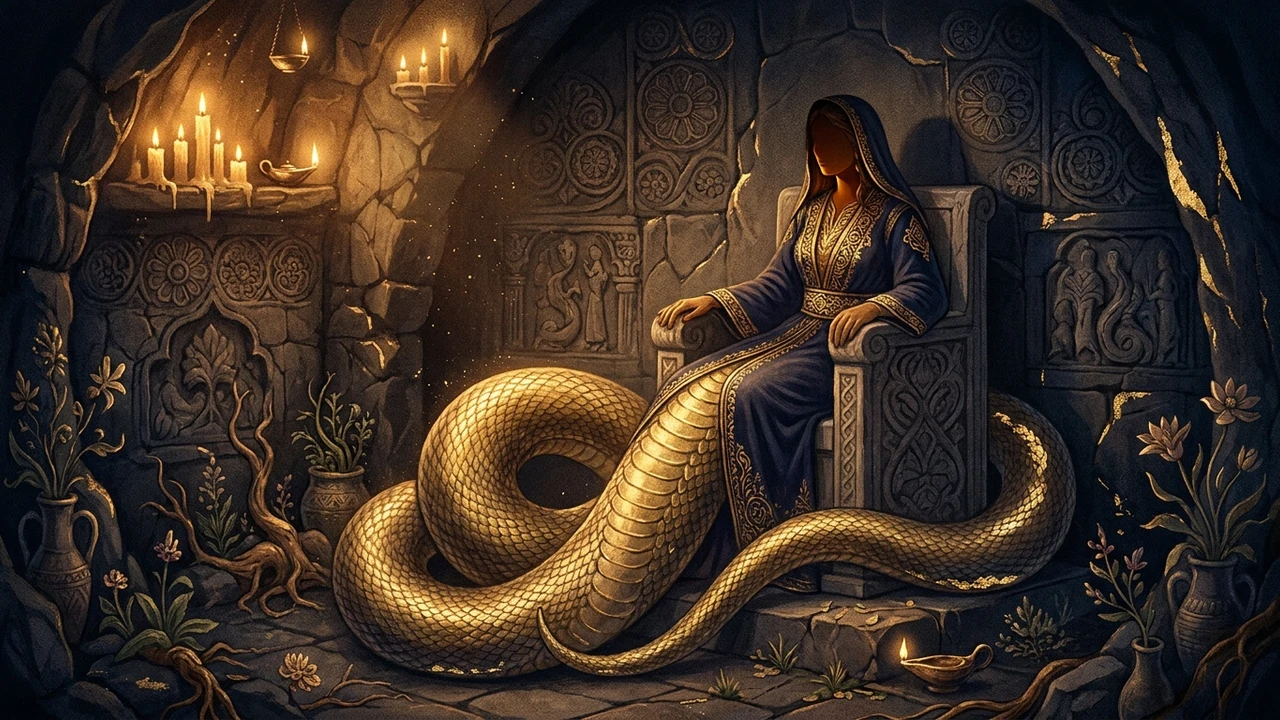
Anyone who looks at the wall of an old mansion in Mardin will see it. Worked under glass, a being half serpent and half woman. Long hair, a crown on her head, large dark eyes, but the lower half of the body is scaled, it coils, ring by ring it winds downward. This is an image you will see all over Anatolia. In Konya, in Diyarbakir, in Tarsus, in Sanliurfa. People hang her on their walls to protect their homes from the harm they believe will come. Her name is Shahmaran. "Shah of the Serpents", meaning queen of the serpents.
But Shahmaran is not really a symbol of evil. When you hear her story you meet something quite different. She is a being who was loved, who loved, who taught, who was betrayed, who was cut to pieces, and who still heals. The people who hang her on the wall know this without knowing it. Because Shahmaran's body carries the deepest paradox: does knowledge defeat love, can love protect knowledge?
Below Tarsus, and the well a young man fell into
The story begins in Tarsus. A group of woodcutter boys go up the mountain. Among them is one named Camasb, young, with bright eyes. One day, walking on the mountain, they see a cave, and at the mouth of the cave a well. At the bottom of the well there is honey, the honey store of some ancient being. The boys talk it over: who will go down, bring up the honey, and they will share it. Camasb volunteers. He is lowered down on a rope.
He fills the baskets with honey, sends the baskets up. When the last basket is pulled up, the friends above take a look: there is more honey in the last basket, and if they do not pull Camasb out, all of it is theirs. They cut the rope and run.
Camasb is left in the well. He weeps one day, weeps two. In the end he gives up hope and begins to look around him. He sees a light leaking through a crack in a wall. With his wounded fingers he scrapes at the stone, scrapes and scrapes, and finally a small hole opens. He looks through the hole. Across from him is a garden. Underground. Full of flowers, trees, and water. In the middle a throne of white marble, and on the throne a being. Half woman, half serpent. Around her thousands of serpents form coiling rings. Shahmaran.
Camasb freezes. The eyes of the serpent queen turn to him. The queen smiles. "Do not be afraid," she says. "You are mine now."
The lessons of the underground
Camasb stays at Shahmaran's side for years. The queen welcomes him first as a guest, then keeps him as a beloved. The serpents grow used to Camasb, they pass against him as if brushing him, they do him no harm. Shahmaran teaches him something new each day.
First she teaches him the herbs. Which leaf eases pain, which root brings down a fever, which seed calls sleep, which flower opens the heart. She tells of every plant of the Tarsus mountains, with its name, its use, and the month in which it is effective when gathered. Camasb learns it by heart. Then she teaches him the language of the animals: what a bird is saying when it sings, what a dog is telling when it barks. She teaches him the phases of the moon, which night a charm will hold, which night no intention will hold at all.
None of this is an ordinary handing on. Shahmaran gives the knowledge like a grace, but at the same time like a trust. At the end of each lesson she looks at Camasb and says, "Tell this to no one. Only you and I know it."
Camasb promises each time. He promises, because he loves the queen. He loses count of the years spent underground. Maybe three years, maybe seven, maybe ten. He stops remembering the world outside the cave.
But one day, one day comes, and Camasb says he misses his mother. The mother he left above. The queen bows her head. She already knew this would happen.
The promise of going up
Shahmaran says, "You may go. But on one condition." Camasb listens. "As long as you are above, you will tell no one of my existence. You will not speak of the underground garden, the language of the cave, the name of the herbs, the kingdom of the serpents. As long as you do not do this, you are safe, and I am safe."
"If one day, for whatever reason, you give me up, that day will be the beginning of your end. What they do to me will cost you your life too."
Camasb swears an oath. He goes up. He embraces his mother. For years he makes up for the pain of his absence. He settles in Tarsus, works as a shepherd, marries, builds a life. But he walks within what Shahmaran taught him. When a neighbour's child falls ill, he knows what herb will help. He does not tell. When a woman has a headache, he knows what should be done. He does not tell. For years he stands within the knowledge, but he does not let it leak out.
The sick sultan and the stone of the bathhouse
Years pass. In a city near Tarsus, one of the sultan's men falls ill. No matter which physician sees him, none finds a cure. The illness is grave, the sultan's most beloved vizier is about to die. A wise woman at the court comes and says to the sultan, "There is only one cure for this. The flesh of Shahmaran. Whoever eats it is healed, whoever drinks of her blood becomes immortal."
The sultan issues an order to find Shahmaran. Word spreads through the whole city. Whoever finds Shahmaran will be given gold. But no one knows where she lives. Because there is only one person who has seen her, and that person has been silent for years.
Here comes the turn of the story. The sultan's wise woman says something strange: "There must be a person who has seen Shahmaran. To find that person, take the whole city to the bathhouse, have everyone undress. The back of a body that has touched Shahmaran will carry the trace of a scale, it shows up no other way." The sultan gives the order. The whole city enters the bathhouse one by one.
Camasb waits his turn. He enters the bathhouse. He undresses. He lies down on the great stone in the middle. On him there truly is, from years ago, an almost invisible trace of a scale. A mark left from brushing against Shahmaran's body, never gone, carried faithfully. The bathhouse attendant sees it. Word is sent to the sultan.
Camasb is seized. He is brought before the sultan. "Tell us where Shahmaran is." Camasb is silent. He is taken to torture. Under torture he stays silent too. But the sultan's men are very cruel, and Camasb's body does not hold. A moment comes, and the mouth says something. On the mountain in Tarsus, beside the cave, there is a well, it says.
To be cut into three pieces
The sultan's soldiers go down into the well. They find Shahmaran. Shahmaran does not flee. She is already waiting for them. They have brought Camasb with them, and when they bring him to the mouth of the well the queen sees him, and a dark drop runs from her eyes. Camasb had promised. But the promise was not kept, because human flesh holds out against an oath only so long.
Shahmaran speaks. "You will kill me," she says to the soldiers, "but do not forget to cut my body into three pieces. The first piece, the head, whoever drinks of its blood, the sultan's sick vizier, is healed. The second piece, the middle, whoever eats of its flesh becomes immortal, but this is the sultan's. The third piece, the tail, whoever eats of it knows the secret of all knowledge, comes into the language of the universe. Give this piece to the one you judge most deserving of evil."
The soldiers do as she says. Shahmaran is cut into three pieces. The first piece is given to the vizier to drink, and the vizier is healed. The second piece is offered to the sultan. The third piece, "deserving of evil", is given to Camasb. Because he is the one who opened the secret, who did not keep his word, who betrayed.
Camasb eats the third piece. And the moment he eats it, all the languages of the world open to him. The name of the herbs, the speech of the animals, the phase of the moon, all of it roars within him. The things he learned over the years are no longer his to hold, they are one with him. He is no longer a physician. He has become knowledge itself.
The sultan eats the middle piece but does not become immortal. Because the true secret of Shahmaran was this: immortality was not in the middle piece. It was in the piece Camasb ate. Shahmaran had arranged this beforehand when she divided her own body. The piece given as "deserving of evil" was in fact the highest gift. Because Shahmaran gave even to the one she loved, even to the beloved who betrayed her, her last gift.
The trust of knowledge
Shahmaran's story does not have a single lesson. It leaves a single question behind. Is it Camasb who betrayed? Is it the sultan's cruelty that set the betrayal off? Is it a love that could not stand in the way of betrayal? All of them? None of them? Although this story wandered from tongue to tongue in Anatolia for centuries, there is no single sentence that ties up the ending, because the real weight of the story is left to the reader as an unanswered question.
Imagine a secret was entrusted to you. Someone you love gave you a piece of knowledge and said, "This is between the two of us only." Years passed, you carried it. Then one day pressure came. There was something you would lose if you did not speak, and a bond whose trust you would turn into betrayal if you did. What do you do in that moment?
What the Anatolian myth says is this: whatever you do, knowledge has found you once, and you have to live with it. If you keep the secret, you live with it; if you open it, you live with it. Both ask a price. Shahmaran's price was death, but Camasb's price was heavier than death. He had to live with an immortal knowledge, and with the memory of disloyalty.
Maybe this is why the homes of Anatolia hang Shahmaran on the wall. That picture carries not her body but her word. "When wisdom is put into words it loses something. But the one who stays silent loses too. Which wound will you carry, choose for yourself." No answer is given to this question, but the question is never forgotten. At the threshold of every secret you live, you give your eyes to Shahmaran and think for a moment. Then you speak, or you stay silent. Either road leads you to a cave, and which one you come out of, only you will know.
You can ask a question about this reading
Atlas (Mit Anlatıcısı) answers your questions about The Secret of Shahmaran: What Is Lost When Wisdom Is Put Into Words
Comments
You can share your thoughts about the piece here.